

Home About
Careers Contact → Client Area
Porto ao anoitecer - comércio exterior entre Mercosul e União Europeia
Comex · Mercosur-European Union Agreement

Mercosur-European Union Agreement

After more than two decades of negotiation, Mercosur and the European Union have created one of the largest trade-preference areas in the world. For those who import or export between the two blocs, this opens a new path to reduce the cost of importing over time.

The Agreement

After nearly 25 years of negotiation, Mercosur and the European Union signed, in January 2026, an Association Agreement that unites two of the largest regional economies on the planet. Once the internal approval stage of both blocs was completed, its commercial part is already in force: since May 1, 2026, thousands of products have operated under tariff conditions different from those applied until then.

The aim of the agreement is to simplify and make trade between the two blocs more predictable. Instead of each company negotiating one-off exceptions for each good, a broad schedule of Import Duty reduction was created, covering most of the tariff universe — from industrial machinery, agricultural products and chemical inputs to consumer goods.

In practice, this benefits companies on both sides of the Atlantic. A Brazilian importer of European equipment may, depending on the product, pay a lower Import Duty than they would buying from a supplier outside the agreement. A Brazilian exporter of food, leather or forestry products gains access to a market historically protected by high tariffs. However, the benefit is not automatic: it depends on conditions set out in the agreement and on actions within the foreign-trade process for it to apply.
Tariff Reduction

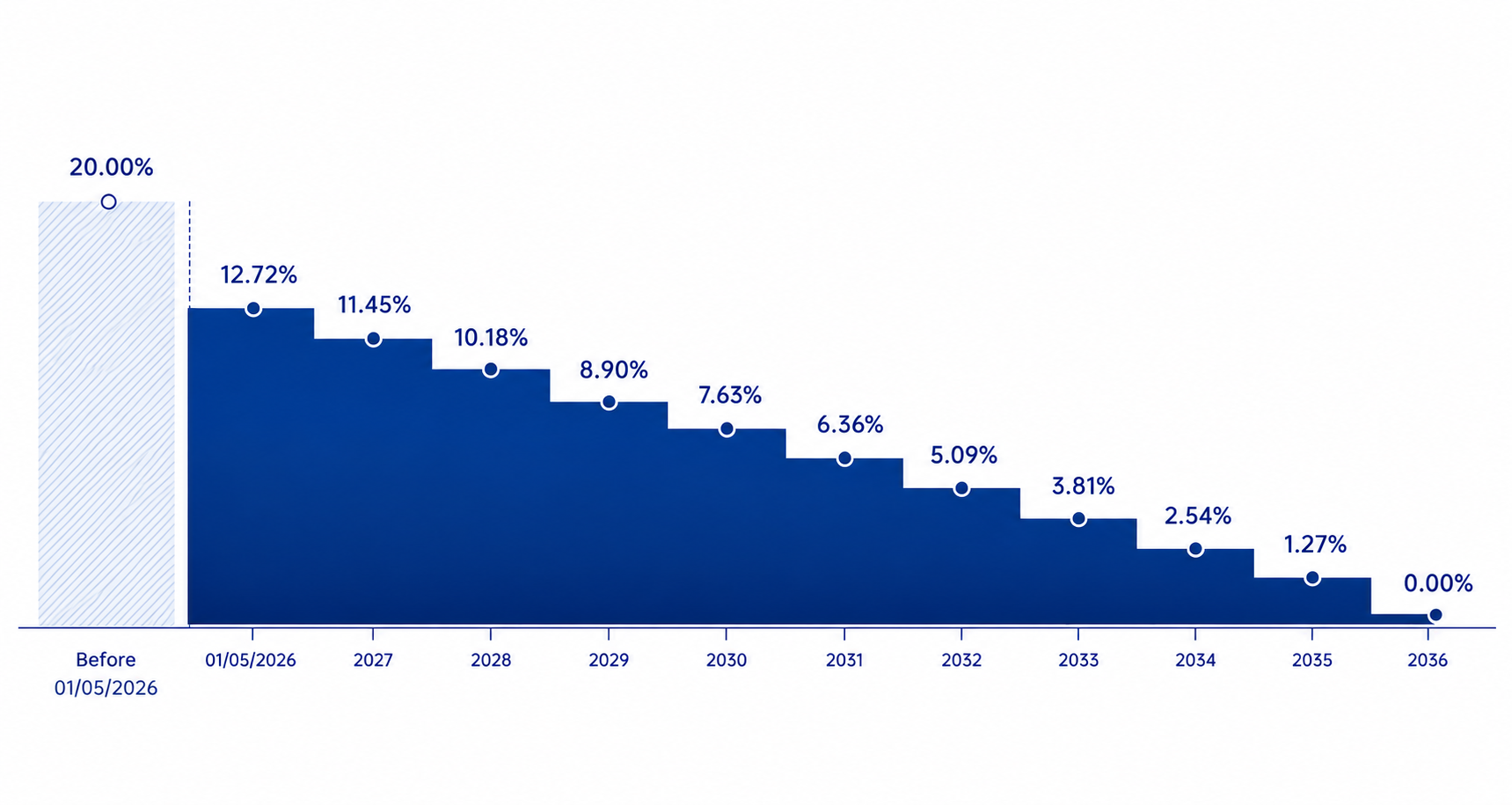
The agreement works through a phase-out schedule: each tariff code (NCM in Mercosur and HS Code in the European Union) is given a predefined term to have its Import Duty reduced to zero, in most cases. Some products have the tariff zeroed immediately; others follow longer calendars of 4, 7, 8, 10 or even 15 years, according to how sensitive the sector is for each bloc. This phase-out or reduction is called a tariff preference — a rate that offers a competitive advantage compared with the one normally charged to countries with no trade agreement with Brazil or the European Union.

A practical example - NCM 90318020, covering three-dimensional measuring machines, had a 20% Import Duty when the agreement came into force. Since May 1, 2026, this rate has become 12.72% under this agreement and continues to fall gradually, year after year, until reaching 0% in 2036, following the schedule negotiated specifically for that tariff code. Many companies are still paying 20% because they are unaware of this benefit or because they import from countries that do not meet the rule of origin.

Illustrative example · NCM 90318020
Cronograma de redução tarifária da NCM 90318020, de 20% antes do acordo até 0% em 2036
Bandeiras do Mercosul, seus países-membros e da União Europeia
Einfach Soluções

"25 years of negotiations for the largest agreement in history between Mercosur and the European Union"

How to check

Before assuming that a product has a tariff reduction, it is worth checking the official databases that support the agreement. On the European side, TARIC (the Integrated Tariff of the European Union) is the EU tariff database that shows the conditions applicable to the entry of each code within the bloc. On the Brazilian side, the official channels linked to Siscomex allow you to check whether a specific NCM already has a tariff preference under the agreement, and what the current schedule for that code is.

These checks do not replace a technical analysis, since each product may have relevant particularities, but they are a good starting point to quickly understand whether it is worth going deeper.

Rule of Origin

This is the point that causes the most misunderstandings. Most importers assume that it is enough for a product to be manufactured or shipped in Europe to be entitled to the tariff preference. It is not quite like that. The agreement requires the goods to meet specific rules of origin, able to prove that they were in fact produced within the bloc granting the benefit.

In practice, these rules assess two things: whether the product underwent enough transformation within the bloc to cease to be, for customs purposes, the same input that entered the factory and, in many cases, what share of its value in fact originates in Mercosur or the European Union. Components brought from countries outside the agreement do not automatically disqualify a product, but the greater their share, the harder it becomes to sustain preferential origin.

Proof of Origin

The Declaration of Origin, like the Certificate of Origin, is the document that formalizes compliance with the rules of origin. Without it, the customs authority has no way to recognize the tariff preference: the product enters normally but pays the full rate, as if the agreement did not exist.

This Proof of Origin works as the key that unlocks the benefit. It does not create the right to the preference, but it is what allows it to be proven at the right time, before the right body, without the company losing the discount over a formal detail.

Client Area
This feature is under development and will be available soon.