

Home About
Careers Contact → Client Area
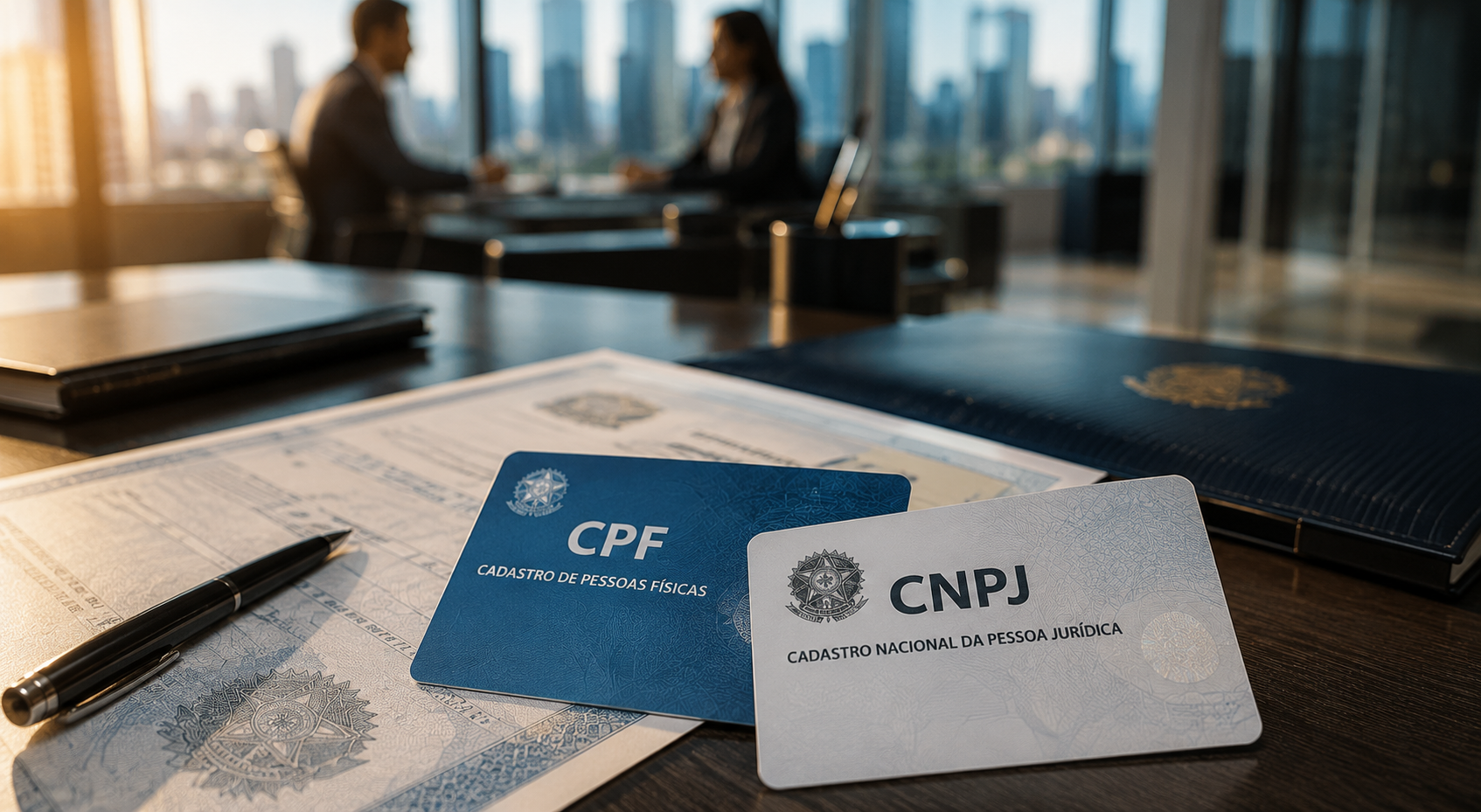
CPF e CNPJ sobre mesa executiva, com skyline de São Paulo ao fundo
International · CPF and CNPJ for Foreigners

CPF/CNPJ for Foreigners

Foreign individuals and companies that intend to invest, acquire assets, hold a stake in a company or operate in Brazil need a registration with the Federal Revenue Service.

Individual

CPF for Foreigners

CPF - What it is and what it is for

The CPF (Individual Taxpayer Registry) is the record the Federal Revenue Service uses to identify any individual before the Brazilian State, whether resident in Brazil or not. For a foreigner, it ceases to be optional the moment their asset, financial or corporate life gains any point of contact with the country.

This happens, for example, when the foreigner buys a property in Brazil, opens an account at a Brazilian bank, makes a financial investment, comes to hold a stake in a Brazilian company, acquires other registrable assets, applies for certain visas or simply needs to present themselves before a Brazilian public body. In all these situations, the CPF is what makes it possible to identify that person unambiguously before the Federal Revenue Service and the other bodies and institutions that rely on it.

Required documents

To carry out the registration, the Federal Revenue Service usually requires the foreigner’s passport, a document proving their parentage — that is, one containing the names of the father and mother — and, when the process is conducted by representation, a specific power of attorney granting powers for this purpose before the Federal Revenue Service.

In some countries there is an international agreement that allows the national identity document to be used instead of the passport. Each nationality and each documentary situation must be analyzed individually before assuming which document will be accepted.

How we do it

Einfach Soluções coordinates this registration end to end, acting as the client’s representative before the Federal Revenue Service. The work begins with analyzing the available documentation and the foreigner’s country of origin, to identify exactly what will be required in each case.

From there, we handle checking the documents received, the sworn translation of those in a foreign language and the registration at the Registry of Deeds and Documents, a step that gives these instruments legal validity in Brazil.

With the documentation ready, a specialized Einfach agent attends the Federal Revenue Service office in person to file the request on the client’s behalf, under the granted power of attorney, and follows the process through to confirmation of the registration.

Timeframe

The estimated time to issue the CPF, once the complete apostilled documentation is received, is up to three weeks. This period may vary according to additional requirements from the Federal Revenue Service office in charge of the review or any need for supplementary documents.

After issuance

A common question arises right after issuance: does having a CPF automatically require the foreigner to file an income tax return in Brazil? No. On its own, the CPF is an identification number. Merely having the registration does not create a tax obligation.

Tax obligations arise from other factors: the status of resident or non-resident for tax purposes, the existence of income or capital gains in Brazil, investments made in the country and other cases provided for by law. For this reason, each situation must be assessed separately. The CPF is the starting point of tax presence in Brazil, not the automatic trigger of an obligation.

Legal Entity

CNPJ for a company domiciled abroad

CNPJ - What it is and what it is for

The National Registry of Legal Entities is the registration required for a company to interact with Brazil. Like the CPF, the CNPJ is a unique identification number that makes it possible to identify the company in the Federal Revenue Service database.

This usually happens when the foreign company opens a subsidiary in Brazil, sets up a holding company to centralize equity interests, makes a direct investment in the country, comes to hold a stake in a Brazilian company, structures a commercial representation or simply starts operating permanently in the national territory.

Documentation

Registering a legal entity domiciled abroad follows a specific procedure before the Federal Revenue Service, distinct from the one used for Brazilian companies. It requires proof of the company’s legal existence in its country of origin through its constitutive documents, such as articles of association or bylaws, as well as identifying its representatives and appointing an attorney-in-fact with specific powers to represent it in Brazil.

As with the CPF, every document produced abroad must be apostilled, and its sworn translation is usually required for use before Brazilian authorities. Depending on the operation, this same documentation also feeds the company’s supplementary registration with the Central Bank.

How we do it

We handle the corporate and documentary structuring needed to enable the foreign company’s CNPJ, organizing the constitutive documents, drafting the power of attorney and coordinating the relationship with Brazil’s Federal Revenue Service, the Board of Trade and, when the operation requires, the Central Bank.

Timeframe

The time to issue the CNPJ of a legal entity domiciled abroad tends to be more variable than that of the CPF, since it depends directly on the complexity of the corporate structure involved and on how quickly the apostilled documents are obtained in the country of origin. The full process usually takes three weeks and may extend when there is more than one company in the ownership chain or additional requirements from the bodies involved.

After issuance

Issuing the CNPJ marks the start of the company’s obligations before Brazil. From that moment, the foreign legal entity is required to keep its data and its representative always up to date with the Federal Revenue Service, along with tax obligations that vary according to the type of operation carried out in the country.

In various situations set out by the Federal Revenue Service, a legal entity domiciled abroad must also identify its ultimate beneficial owners — the individuals who, ultimately, control or benefit from the company. Einfach conducts this survey together with the client, both when setting up the CNPJ and in the subsequent registry maintenance.

Client Area
This feature is under development and will be available soon.